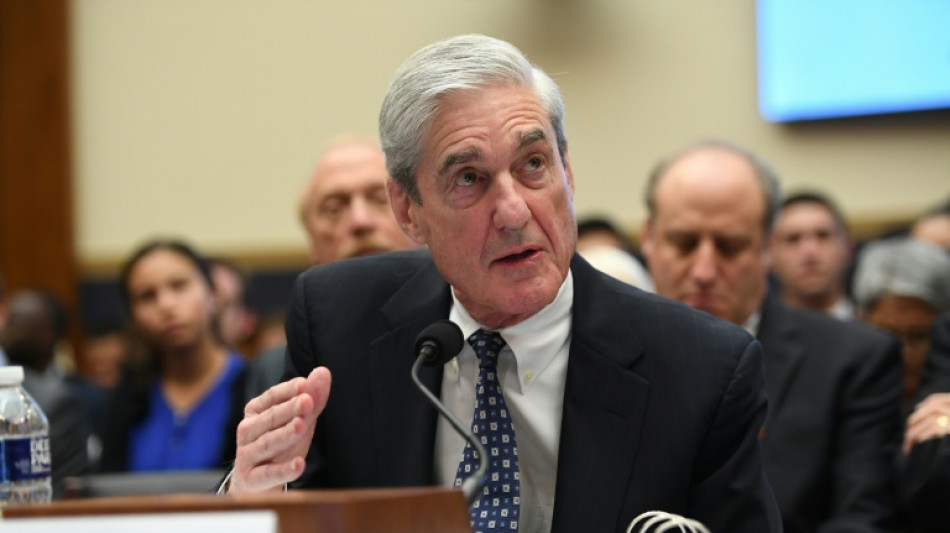
Robert Mueller, ex-FBI chief who led Trump-Russia inquiry, dead at 81 / Photo: SAUL LOEB - AFP/File
Robert Mueller, the former FBI director who led a politically explosive investigation into Donald Trump, has died aged 81, triggering a gloating response Saturday from the US president.
US media reported that Mueller died late Friday, citing a family statement, but did not specify a location or cause.
Trump responded quickly on Truth Social, writing: "Robert Mueller just died. Good, I'm glad he's dead. He can no longer hurt innocent people!"
Mueller led the FBI for 12 years, starting just days before the September 11, 2001 Al-Qaeda attacks on the United States, during which time he built up the bureau's counterterror mission.
After his tenure at the FBI, he was tapped as a special counsel for the Justice Department to lead an investigation into whether Trump's presidential campaign conspired with Russia to get him elected.
Starting in 2017, Mueller operated for two years quietly behind the scenes, emerging in July 2019 to testify before Congress about the probe that Trump regularly denounced as a "witch hunt."
For many Americans, the nationally televised hearing was the first close look at the patrician, grey-haired former FBI director.
What many saw was a cautious career prosecutor who was forced to testify under duress and who deflected questions from both Democrats and Republicans by referring repeatedly to his voluminous report.
Mueller said his report did not exonerate Trump but he mostly deflected questions from lawmakers seeking to score political points for their sides.
- A 'straight shooter' -
That was in keeping with the career of a public servant who had spent four decades serving both Democratic and Republican presidents.
Before taking on the politically sensitive Russia investigation, Mueller, a former marine who was wounded and decorated for heroism in Vietnam, enjoyed a sterling reputation in Washington.
Mueller is a "consummate professional and a straight shooter," then-FBI chief Christopher Wray, a Trump appointee, said in July 2019.
As a young prosecutor in San Francisco and Boston, Mueller took on cases involving grisly murders, organized crime, fraud by powerful banks and terror attacks -- winning some, losing some, but rarely drawing serious criticism for his work.
At the FBI, he gained a reputation of being an exacting taskmaster and, despite his early Republican political alignment, someone who was appreciated by politicians of both political parties.
Two of his most heralded prosecutions involved New York mobster John Gotti and General Manuel Noriega of Panama.
After retiring in 2013, he joined a private Washington law practice where he handled official arbiter missions.
Trump's May 2017 firing of Mueller's successor at the FBI, James Comey, resulted in Mueller being recalled to public service to lead the investigation into suspected Russia meddling.
Over 22 months, his investigators issued charges against 34 individuals, including six Trump associates, and three companies.
Born August 7, 1944, in New York City, Mueller grew up on Manhattan's tony upper East Side. He attended the elite, and at the time all-male, Princeton University where he earned his bachelor's degree in 1966.
After college, Mueller enlisted in the US Marines, and after one year as an enlisted man, entered officer candidate school. As a marine, Mueller earned a Bronze Star for valor and a Purple Heart for wounds received in combat.
In 2001, he took over an FBI beset by scandals, including the years-long deception by FBI mole Robert Hanssen and the agency's failure to turn over thousands of pages of investigative documents to Oklahoma City bomber Timothy McVeigh's attorneys.
Then-president George W. Bush and legislators agreed that Mueller was the person to set the bureau right. "His skills should be a perfect match for the challenge," Republican Senator Jeff Sessions said at the time.
Chuck Schumer, a Democrat, heartily agreed. "Bob Mueller," he said, "will give the FBI a major boost that will help it get back on its feet."
O.Hofmann--NWT