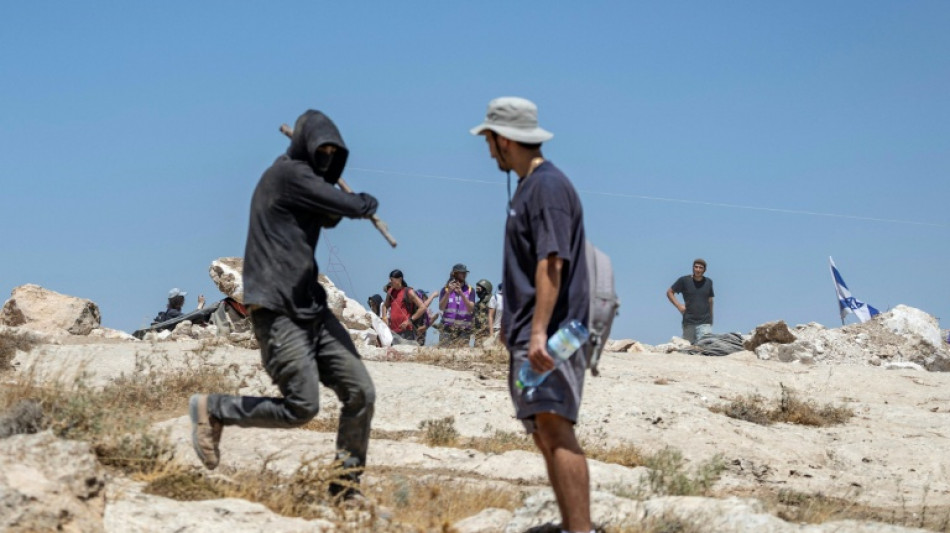
Driven by faith, activists stand up to fellow Jews to protect Palestinians / Photo: ilia YEFIMOVICH - AFP
Ziva Sharp said her Jewish faith motivated her to travel from Jerusalem to the West Bank to stand up for Palestinians -- a commitment that led to her being set upon by fellow Israelis also professing to be driven by Judaism.
Sharp and around 30 other activists are part of a small movement of Israelis, many of them religious Jews, who periodically go to the occupied West Bank with a mission to protect Palestinians under growing assault by violent settlers.
On Tuesday, at least five of the activists were injured as settlers violently expelled them, throwing stones, unleashing pepper spray and injuring this AFP journalist, who was hit in the chin with a stick.
Sharp said she joined the movement to "practice my commitment to my Judaism, which is humanistic and not violent", and to "decrease, to the extent that we can, the damage the Jewish people do to the Palestinians".
She said her inspiration came from Jewish religious texts. "We are supposed to be part of tzelem elokim (the image of God), and to follow God's ways, and God's ways are pity, compassion and justice."
The activists travelled to Jannatah, near Bethlehem, to build a protective fence around the home of the Faraj family, who have come under pressure from Jewish extremists.
A member of the Palestinian family, Mohammed Faraj, was killed in clashes with settlers in March, and several relatives were wounded. Nobody has been arrested over the killing, his brother Hassan told AFP.
The activists went to clear road obstacles blocking the Faraj family after settlers put up a prefabricated home on the family's private land.
The activists and accompanying journalists returned to find their cars vandalised, with windows smashed and tyres punctured.
After activists went to confront the settlers, two cars full of settler reinforcements -- many of them young and wearing dark hoodies -- rushed in to attack the visitors.
According to the activists, the settlers' outpost, dubbed Kochav Yehuda, has been dismantled 64 times by Israeli authorities and rebuilt each time, most recently on Monday, the day before the activists' visit.
The encroaching settlers belong to the extremist Hilltop Youth movement, which seeks to pressure Palestinian residents to abandon their homes -- often through violence -- and to establish outposts that are illegal even under Israeli law, in the hope they will later be legalised and upgraded into full settlements.
More than 500,000 Israelis live in the West Bank, which Israel has occupied since 1967, and which is home to around three million Palestinians.
Prime Minister Benjamin Netanyahu's right-wing government is advancing more settlement construction ahead of October 27 elections.
Violence against Palestinians by Israeli settlers has increased dramatically since the October 7, 2023 attack on Israel by Hamas from the Gaza Strip.
- Children of Abraham -
Many of the Israeli activists are part of Bnei Avraham (Children of Abraham), a movement of religious Jews named after the Biblical patriarch regarded in tradition as the common forebear of Jews, Muslims and Christians.
Unlike the broader Israeli peace movement, which is largely secular, it was founded four years ago by a group of religious Jews who said their faith compelled them to confront what they saw as injustices against Palestinians.
That stance has placed them in direct opposition to religious Zionist extremists who invoke Judaism to justify expelling Palestinians from their land.
Avishai Liss, 26, who grew up in a religious Zionist community in northern Israel, has been active with Bnei Avraham for more than a year.
"I feel as a Jewish person, as a Zionist, that what's happening now in the West Bank is not Jewish. And it's definitely not moral. And that's why I come here, to help the Palestinian people, to defend their houses from the violent settlers," he told AFP.
He said his activism had strained his relationships within his own community but that he believed Judaism came in many forms.
"You can be a Fascist Jew, like them... and think that all your Judaism is about conquering land and trees and destroying and using violence," he said.
"My Judaism is to love the creation that God has created."
Dror Nadel, 27, grew up in an ultra-Orthodox community outside Tel Aviv but left the fold as a teenager and became secular.
He said his ultra-Orthodox upbringing had shaped his "socialist" outlook, as his father had followed the Jewish commandment to give charity to the poor.
The Jewish way of thinking "helped me to analyse the conflict and what I wanted to do, and how I want to be involved in this conflict in a different way", he said.
"I think religion is a really dangerous thing," Nadel said. "It's a really beautiful thing, but it can lead you in really wrong directions."
"This is why we need to study our religion and to research it, even in the 21st century, to see what we got wrong and how we can fix it."
W.Schwarz--NWT