Illegal mining ravages S.Africa's economic hub / Photo: EMMANUEL CROSET - AFP
Whole chunks of a once-busy road in Johannesburg have collapsed because of damage caused by the illegal mining rampant across South Africa's economic hub.
Elsewhere along Wemmer Pan Road are cracks and sinkholes from underground blasting by irregular miners digging under the city for gold and other minerals.
The round-the-clock operations are undermining Johannesburg's infrastructure -- from transport and power networks to homes and buildings -- and introducing crime linked to competition between gangs, residents and officials say.
"At first it was the blasting and the tremors from underground, and we would feel our flat shake," 45-year-old Voneen Trompeter told AFP in Roodepoort, northwest of central Johannesburg.
"Now there are shootouts in the area. It is scary."
Illegal mining in South Africa pulls in thousands of impoverished men from countries around the region who can spend days underground at a time.
Known locally as zama zamas, which means "those who try" in Zulu, they are mostly heavily armed and descend deep into shafts abandoned by mining companies, or dig out new ones.
They steal electricity cables, damage water pipes and dig up roads, said Michael Sun, a member of the provincial legislature in Gauteng, which includes Johannesburg.
"Who gets to suffer? The residents get to suffer," he said.
- City of Gold -
A businessman in Denver, near central Johannesburg, showed AFP a gaping hole around 100 metres (300 feet) from the entrance of his factory from where he said a large number of illegal miners emerged each week.
"We are worried about what is happening beneath our buildings," the 63-year-old said, asking to remain anonymous for fear of retaliation.
He pointed out cracks in the premises that he said were caused by underground blasting.
The city's electricity network said its infrastructure is being wrecked.
"Underground excavations have compromised ground stability, placing substations, transformers, pylons and transmission towers at risk," City Power spokesman Isaac Mangena said.
"In some areas, infrastructure has already begun to sink as illegal mining activity continues to expand beneath the surface," he said.
President Cyril Ramaphosa deployed troops across Gauteng province in March to bolster police operations against crime and illegal mining.
Johannesburg -- reported to be the richest city in Africa -- was born from a gold rush in the 1880s. While regular mining continues in parts, there are also hundreds of abandoned shafts along the main gold reef.
While some are being reworked by zama zamas, many are filled with acidic water that contributes to sinkholes, said mining expert David van Wyk.
"Things are still going to get worse in terms of infrastructure damage," said van Wyk, who estimates that there are more than 34,000 irregular miners in South Africa.
People living in informal settlements built on mine waste dumps are falling ill and more "houses will crack and fall into sinkholes", he said.
- 'They rule' -
In a mining village outside Carletonville, about 74 kilometres (46 miles) west of Johannesburg, zama zamas have taken over an abandoned school, barring anyone else from coming near.
Outside, men sat in groups, some draped in blankets, while others carrying shovels and wearing mining boots appeared to be returning from nearby shafts. They said they were from Lesotho and Mozambique.
One told AFP he could earn up to 15,000 rand (more than $900) on a good day and more than 100,000 rand a month.
"I have been here for four years, and this job feeds my family," said the 27-year-old father of three from Lesotho.
The area had become "chaotic" since the miners took over, said local councillor Moiketsi Ntilane, 44.
"They are the authority," he said. "Families live in fear. They are ruthless, gun-toting and happy to kill."
Outside of Gauteng, in the North West province, the damage and fear brought by illegal mining was stark in the village of Bapong, about 65 kilometres northeast of Johannesburg.
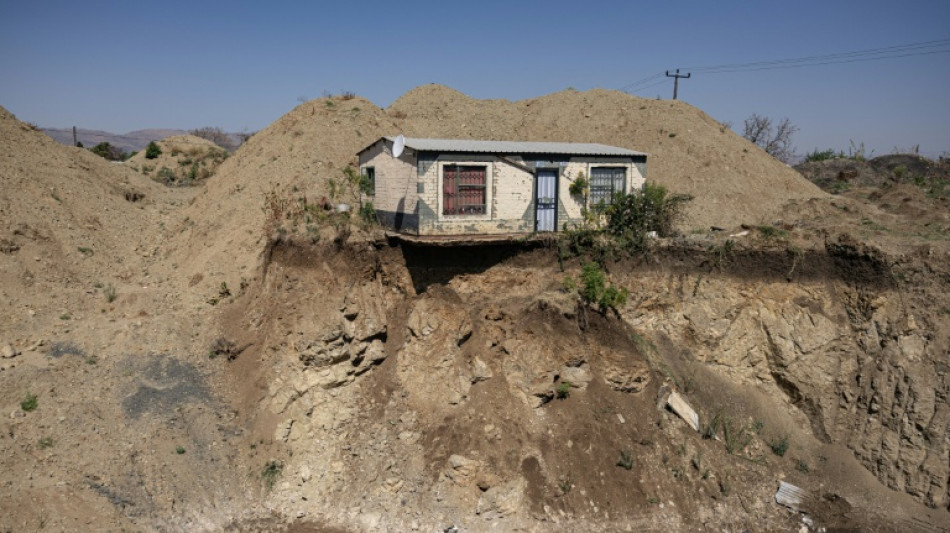
Several homes stood dangerously close to the edge of massive pits dug with excavators by miners seeking access to chrome deposits.
While regular police and military patrols now keep the zama zamas at bay, the community lives with the damage, said 63-year-old resident Sarah Rakgwanhla.
"The holes are dangerous because they have water, and our children pass by them every day on their way to school and to the shops," she said.
"We need help to have these holes sealed."
A.F.Ebner--NWT