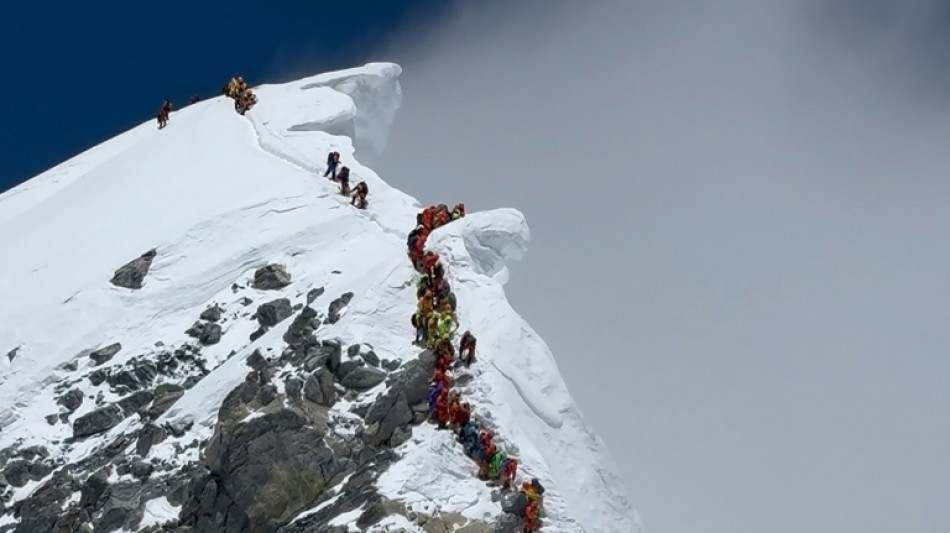
Tenzing Norgay's son says Himalayas sending climate warning / Photo: Furte Sherpa - AFP/File
As a new biopic puts the life of mountaineer Tenzing Norgay Sherpa on screen, his son says climate change is transforming the Himalayas and making mountaineering increasingly dangerous.
Released on Friday, "Tenzing", an Apple TV film, recounts the first confirmed ascent to Everest's summit in 1953.
But it focuses on the journey from the perspective of Tenzing Norgay Sherpa who, together with Edmund Hillary, completed the climb that until then was deemed impossible.
More than seven decades after Sherpa stood atop the world's highest peak, Nepal is grappling with the aftermath of catastrophic flood that has put a spotlight on the impact of climate change on mountains.
Jamling Tenzing Norgay Sherpa, 61, said that these disasters are "a warning for us".
"Nepal is very vulnerable to this because half our country is covered with mountains," he told AFP.
"That's going to affect the people living lower down below the valley along the river."
Two years ago, Sherpa saw that his father's village Thame, at an altitude of 3,800 metres (12,460 feet), was swept away by a devastating flood caused by a glacial lake outburst.
"It's a big threat. The moment glaciers recede... the lakes are going to rise and then one day, it's going to breach and break. And that's exactly what is happening," he said.
"It happened in Thame, half of the village was wiped off (the map)."
- 'Price to pay' -
The younger Sherpa followed in his father's footsteps to Everest in 1996, a dream he had since he was eight years old.
"I looked up to him as my greatest role model, you know, he was my hero, and I wanted to become just like him," he said.
But the signs of global warming are appearing on Everest itself.
Sherpa said that guides are now finding water appearing at Camp 2 about 6,400 metres (21,000 feet) high.
"There was never water at all. It's always solid ice up there," he said.
Sherpa said that comparative photographs of the mountain show how much the glaciers have receded since his father's climb.
For climbers and mountaineering Sherpa community, the changes are also making their occupation more dangerous, with unpredictable weather and frequent avalanches.
"I think we have to be very careful now as to how we look at mountains and how we approach climbing mountains nowadays," he said.
Sherpa said that the responsibility of addressing climate change lies largely with the world's biggest emitters.
"It's not only affecting us in the Himalayas, it's affecting European countries, it's affecting places in the US with all these wildfires,' he said.
"If we don't start taking care of our planet, there's going to be a price to pay."
- 'Long overdue' -
The climate-induced disasters affecting mountain communities form a striking backdrop as the film premiers -- featuring Genden Phuntsok in the title role, with Tom Hiddleston as Hillary, as well as Willem Dafoe.
Tenzing Norgay Sherpa's story was long overshadowed in previous accounts told from a Western perspective of the historic trip up the mountain, which measures 8,849 meters (29,032 feet).
"I think it was long overdue, a film, a biopic about my father, his life," Sherpa said, adding that the pioneer did not get the recognition he deserved.
"But at the same time, he really didn't care about it. It wasn't the fame he looked for, why he climbed the mountain. He climbed because it was his passion and he had a dream to climb this mountain," he said.
Tenzing Norgay Sherpa's historic climb made the term 'Sherpa' synonymous with courageous mountain guides and workers.
Sherpa said that while mountains were a passion for his father and many Nepali climbers are getting recognition, financial necessity still drives the mountaineering industry.
"The Sherpas climb today to keep bread and butter on the table, you know, to feed their children, to give their children a good education, so their children wouldn't have to do the same thing," he said.
That economic dependence makes the changing conditions in the Himalayas particularly significant for Sherpa communities whose livelihoods are tied to mountaineering.
"While he (Tenzing Norgay) was still alive, before the 80s, nobody talked about climate change because we didn't see the changes," he said.
"We notice this now."
P.Mayer--NWT