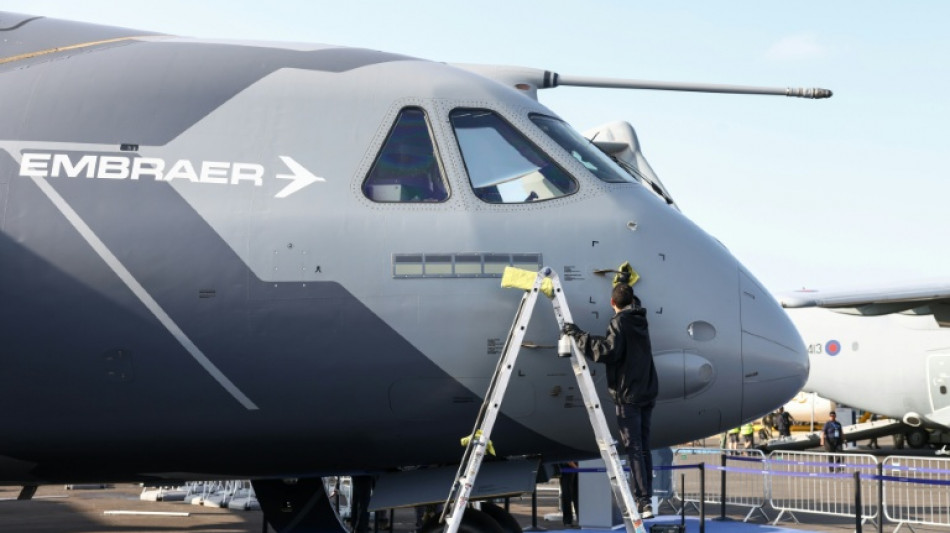
Brazil aircraft maker Embraer raises outlook after record revenue / Photo: Toby Shepheard - AFP
Brazilian aircraft manufacturer Embraer said Monday it expects higher profits than previously forecast in 2026 after record second-quarter revenues and an all-time high order backlog.
The world's third-largest aircraft manufacturer after Airbus and Boeing, Embraer said it expects about $110 million more in profits.
A portion of this increase is due to relief from direct US tariffs on Brazilian goods -- from which civil aircraft and aerospace products have been exempt.
Embraer still expects about $12 million a year in indirect tariff-related costs.
Chief financial officer Felipe Santana said most of the additional profits were from a one-off tax credit of $68 million, which he described as a "refund" of previous tariffs.
Revenue rose 23 percent to $2.24 billion in the second quarter.
Meanwhile, the company's pipeline of orders of its commercial, business and military aircraft reached a record $34.5 billion.
"We delivered the strongest second-quarter revenue in our history. We achieved our highest second-quarter deliveries in the past 16 years and reached a new all-time high backlog for the seventh consecutive quarter," said CEO Francisco Gomes Neto.
Embraer delivered 65 aircraft during the second quarter, up from 61 a year earlier.
Gomes Neto highlighted an order of 10 of the company's KC-390 military transport aircraft by the United Arab Emirates -- the largest international order to date.
This month, Colombia ordered two of the aircraft.
"Because of the geo-political situation we have seen countries accelerating sales campaigns," said Gomes Neto.
He added that despite higher ticket costs, the air transportation industry had been "extremely resilient... people are still flying" and demand was still rising for new planes.
Embraer executives also gave an update on Eve Air Mobility, a subsidiary developing electric "air taxis" designed to shuttle passengers above congested city streets.
This month, Eve achieved its first transition flight, showing its prototype can take off vertically like a helicopter and move into flight like an airplane, which is one of the most challenging phases of development.
P.Mayer--NWT