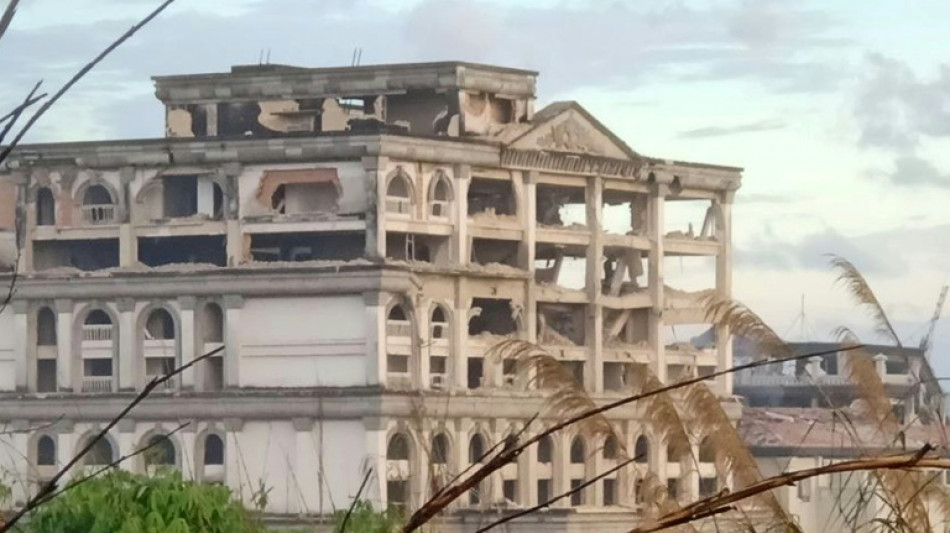
Border casinos caught in Thailand-Cambodia crossfire / Photo: Handout - Agence Kampuchea Press (AKP)/AFP
Thailand has struck multiple casinos linked to cyberscamming in neighbouring Cambodia during an almost two-week-long border conflict, with the prime minister saying he would "take care" of fronts for fraud operations.
Across Southeast Asia, criminal gangs have used casinos, hotels and fortified compounds to carry out sophisticated cyberscams, according to the UN Office on Drugs and Crime, often relying on trafficked people.
Cambodia hosts dozens of the scam centres with an estimated 100,000 people -- many victims of human trafficking -- perpetrating online scams in a multibillion-dollar industry.
At least four casinos on Cambodia's border with Thailand -- two which monitors have identified as scam hubs -- have been struck this month in a military conflict between the neighbours that has killed dozens and displaced more than half a million.
UN human rights chief Volker Turk said Thursday that trafficked foreign nationals forced to carry out scams in Cambodia were "now exposed to further risk by the fighting", and called for their evacuation.
But efforts to make peace with Cambodia rested on Phnom Penh's commitment to "destroy scamming attempts", Thailand's Prime Minister Anutin Charnvirakul told reporters at an international anti-scam conference in Bangkok on Wednesday.
If casinos in Cambodia were hiding fraud operations behind their doors, "then we will regard it as a scamming centre that we need to take care of", he said.
Rights abuses in Cambodia's scam centres are happening on a "mass scale", and the government's poor response suggested its complicity, said a June report by Amnesty International.
But Ros Phirun, secretary general of Cambodia's Commercial Gambling Management Commission, told AFP that authorities were taking "serious action" to crack down on scams, and called Thailand's action on the border casinos "totally illegal".
- Casinos targeted -
Thailand last week said it attacked three casinos across the border which the Thai army claimed were being used as Cambodian weapons storage facilities and firing positions.
"Every scam centre and casino we attacked, we had clear intelligence that it was used as a military base," deputy Thai army spokesman Richa Suksuwanon told reporters on Thursday.
But some casinos caught in the crossfire reportedly housed civilians.
A UN statement on Thursday cited a survivor of a strike in Oddar Meanchay province who told the Human Rights Office that one civilian was killed and two others wounded.
The O'Smach resort and casino -- identified by Amnesty International as a scam compound -- was built by Cambodian conglomerate L.Y.P Group headed by Cambodian senator Ly Yong Phat.
He was sanctioned by Washington last year over his firm's alleged role in "serious human rights abuses related to the treatment of trafficked workers subjected to forced labor in online scam centers".
Last month, Thailand issued an arrest warrant for the tycoon for his alleged involvement in transnational crimes, and seized $300 million in assets from other Cambodian businessmen.
O'Smach and other casino sites Thailand targeted had potentially thousands of victims of human trafficking inside, according to Jacob Sims, a visiting fellow at Harvard University's Asia Center.
"Bombing scam compounds is not a reasonable approach to combatting the scam industry," he told AFP, adding that Thailand's asset seizures were more effective.
But, "the existence of the scam compounds -- and the world's mounting frustration at Cambodia for hosting a globally predatory industry -- offers Thailand a useful pretext for extraterritorial aggression that would otherwise likely be condemned".
burs-sjc/sco/tym/fox
G.F.Koller--NWT