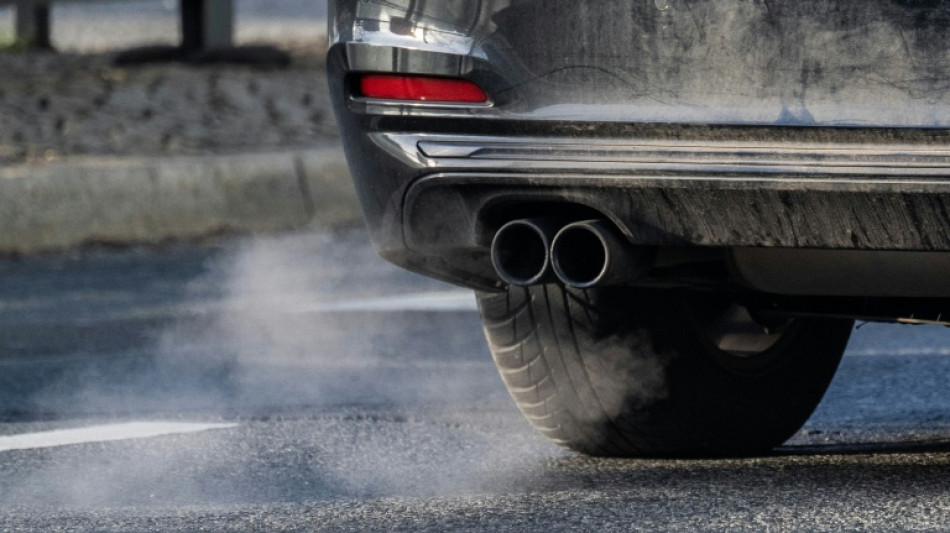
German court to rule in climate case against automakers / Photo: John MACDOUGALL - AFP/File
Germany's Federal Court of Justice is due to rule on Monday in a landmark climate case brought by environmentalists against auto giants BMW and Mercedes-Benz.
Campaigners of the group Environmental Action Germany (DUH) argue that the car manufacturers should be forced to stop selling combustion engine cars after 2030.
The case builds on a landmark 2021 ruling by Germany's Constitutional Court that the state has a duty to protect future generations from the effects of climate change and seeks to apply the principle to companies.
The European Union had originally planned to phase out fossil-fuel-powered cars by 2035, but weakened those rules late last year following intense lobbying by automakers to allow some sales to continue.
DUH campaigners Barbara Metz, Sascha Mueller-Kraenner and Juergen Resch argue that continued combustion-engine car sales after 2030 would be a violation of the German Basic Law or constitution.
"Corporations must operate their business models in a way that is compatible with a future worth living for all people," Resch said last year.
"We have the Constitutional Court's 2021 ruling on climate protection which specifically states that failing to take sufficient action to protect the climate is a violation of fundamental rights," the plaintiffs' lawyer, Remo Klinger, told AFP.
"This is the first time this kind of argument has come before the Federal Court of Justice."
- 'Legislature, not courts' -
A key question in the case is whether the auto giants could be forced to stop selling polluting cars without the government directly legislating on the issue.
In a statement, BMW told AFP that "the debate over how to achieve climate targets must take place within the political process through democratically elected parliaments".
Mercedes-Benz agreed, maintaining that "the legislature, not the courts" should decide specific climate targets.
The legal action is part of a wider trend of activists turning to the judiciary to enforce climate action.
Campaigners celebrated last May after a regional court in northern Germany ruled that companies could in principle be sued over the consequences of their emissions.
However, the court did not award damages to a Peruvian farmer, Saul Luciano Lliuya, who had brought the case against utility firm RWE.
The case against the carmakers was passed up to the Federal Court of Justice on appeal after lower courts in Stuttgart and Munich ruled in favour of the firms, finding they had complied with relevant regulations.
German carmakers have invested billions in the transition to electric and hybrid vehicles in a bid to meet EU climate targets.
But progress has been slowed by lower than anticipated demand, with many consumers put off by higher upfront costs and still patchy charging infrastructure.
Speaking earlier this month, Barbara Metz said the plaintiffs would consider an appeal to the Constitutional Court if Monday's judgement went against them.
L.Pichler--NWT