Rio favela residents vote with little hope / Photo: Tercio TEIXEIRA - AFP
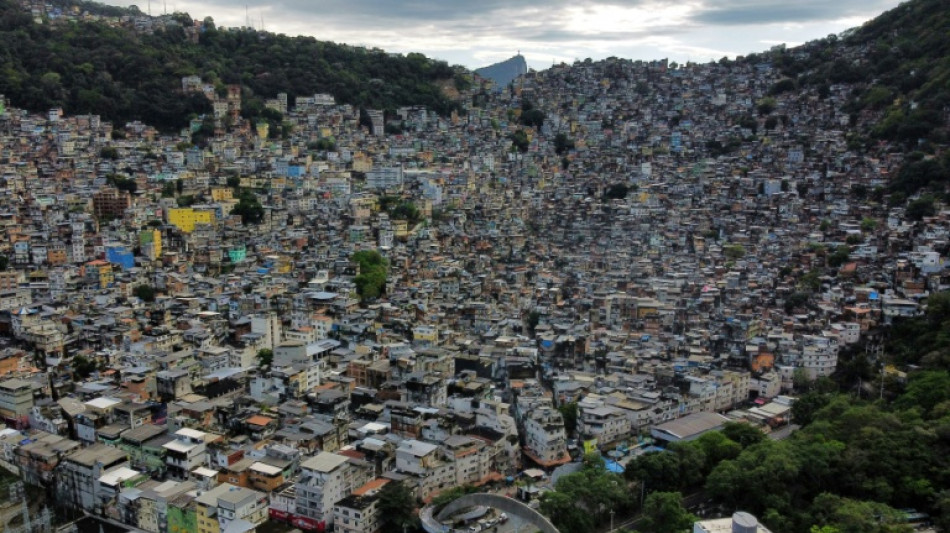
Ground down by violence and the struggle to make ends meet, residents of Rio de Janeiro's largest favela voted Sunday, with little faith that the result will change much in their troubled hillside city within a city.
Queues of voters, some a hundred long, snaked down Rocinha's sloping streets, where about 100,000 people live in tightly packed brick homes clinging to the steep escarpment.
They are choosing between a dozen presidential candidates, with security, sanitation and the cost of living front of mind.
"You're not safe on the street. You're not even safe inside your own home," said 70-year-old Antonio Machado.
"You're inside your house when a stray bullet comes flying in," he said.
For decades, through governments left and right, drug gangs and heavily armed police have fought bloody battles for control, all within sight of the golden sands and lapping waves of the south Atlantic.
"It is shameful, the state of this country," said Machado. "Politicians only seek you out during election season. Afterward, they don't even know you exist."
- 'The option we have' -
This time the frontrunners are leftist incumbent Luiz Inacio Lula da Silva and right-wing senator Flavio Bolsonaro.
Bolsonaro has pledged to restore state control and "suffocate" armed groups like the Comando Vermelho and First Capital Command, which have survived numerous police raids and crackdowns, and several changes in government.
Bolsonaro has vowed to designate them as terrorist organizations, after US President Donald Trump's administration did so earlier this year.
He has also praised the harsh security policies of El Salvador's President Nayib Bukele, and plans to emulate him in building more maximum-security prisons.
Lula has also vowed to "reclaim the territory."
Violence is "something that's been dragging on for years and years," said Fabricia de Melo, a biomedical scientist.
But for her, Lula is "the lesser of two evils."
"Not that he'd be the best option, but he's the option we have right now," the 27-year-old told AFP.
Flavio Bolsonaro's father, jailed ex-leader Jair Bolsonaro, encouraged police intervention in Brazil's crime-ridden neighborhoods when in office.
That does not sit easy with some residents.
"As a Black person, I don't trust the police," De Melo said. "Because when they come in, they break into homes and assault people."
Police in Brazil killed on average 17 people a day between 2019 and 2025, according to the Brazilian Public Security Forum, a non-governmental group.
- Patience wearing thin -
Lula is adored by many for social welfare programs that lifted millions out of poverty during his first two terms in the 2000s.
But, for some, patience has worn thin.
"We suffer from many problems regarding basic sanitation and education," said bricklayer Maicon Santana, 22.
"I'm not very pleased with this administration. It hasn't done anything."
Tech worker Joao Batista, 36, voted for Bolsonaro. He was fed up with the "horrible" expense of basic goods "that should be affordable for the average citizen."
"Things are truly terrible. As far as I'm concerned, the left just doesn't work anymore."
Lula introduced a flurry of crowd-pleasing measures during the final weeks of the campaign.
He increased welfare payments and banned sports betting that has drawn many into gambling addiction and debt.
"Lula's administration isn't perfect, but he does what he can," said photographer Ana Elise de Oliveira, 23.
cc/fb/arb/dw
A.Hofer--NWT